
1
/
의
1
Fiat
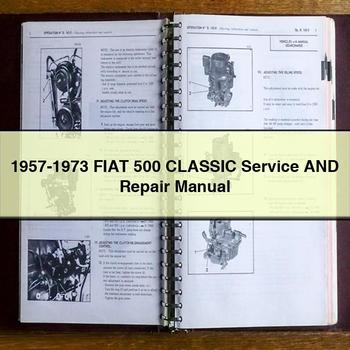
1957-1973 Fiat 500 Classic Service And Repair Manual
1957-1973 Fiat 500 Classic Service And Repair Manual
정가
$17.99
정가
할인가
$17.99
배송료는 결제 시 계산됩니다.
Vehicle data plateRef 508277
- Brand
- Fiat
- Vehicle
- Tractors
- Models covered
- 500, 500 Classic, Agriculture
- Years
- 1957, 1958, 1959, 1960, 1961, 1962, 1963, 1964, 1965, 1966, 1967, 1968, 1969, 1970, 1971, 1972, 1973
- Format
- PDF, searchable, print-ready
- Delivery
- Instant download after checkout
- Language
- English
픽업 사용 가능 여부를 로드할 수 없습니다.
What happens after you pay
- Download link opens on the order page immediately
- The same link is emailed to you — re-download any time
- Open on phone, tablet or PC; print only the pages you need
- Not sure it covers your model year? Ask us before you buy
🏷️ Basic Information
Identification
Make:
Fiat
Model:
500
Generation:
Original (Nuova 500)
Applicable Years:
1957-1973
Codes
Chassis Codes:
Nuova 500, 500 D, 500 F, 500 L, 500 R, Giardiniera
👋 Introduction
Market Position
Vehicle:
The Fiat 500 (Nuova 500) was an iconic Italian city car, designed for affordability and practicality. It became a symbol of post-war Italian economic recovery and personal mobility.
Competitive Analysis
Vehicle:
Competed primarily with other small European microcars like the Volkswagen Beetle, Citroën 2CV, and BMC Mini, but distinguished itself with its unique design and Italian flair.
Key Features
Manual:
Authentic, dealership-level service information. Specificity to the Fiat 500 model, ensuring accuracy and completeness beyond generic guides. Covers a wide range of repairs and maintenance tasks.
📋 Manual Details
Coverage Areas
General:
Covers all models and all repairs A-Z for Fiat 500 (1957-1973).
Page Count
Estimated:
Likely over 300 pages (typical for comprehensive service manuals of this era).
Manual Type
Type:
Classic Service and Repair Manual
Language
Primary:
English
Format
Physical:
Likely printed book (as implied by 'exact same manual used by technicians at the dealerships').
Clarity Of Diagrams:
Likely features detailed line drawings and exploded views essential for understanding complex assembly procedures.
📖 Manual Coverage
Systems Covered
Engine:
Detailed coverage of engine disassembly, assembly, tuning, and troubleshooting. Includes information on cooling, lubrication, and fuel delivery systems.
Transmission:
Comprehensive coverage of manual transmission removal, inspection, repair, and reinstallation. Includes clutch system service.
Brakes:
Detailed procedures for brake system maintenance and repair, including hydraulic systems, master cylinder, wheel cylinders, brake shoes, and drums.
Electrical:
In-depth coverage of the vehicle's electrical system, including wiring diagrams, lighting, ignition system, starter motor, generator/alternator, battery, and instrumentation.
Suspension Steering:
Coverage of front and rear suspension components, including shock absorbers, springs, and steering mechanism.
Body Chassis:
Information on body panel repair, door mechanisms, interior trim, and chassis components.
Fuel System:
Detailed coverage of carburetors (e.g., Solex, Weber variations depending on model/market), fuel tank, fuel lines, and fuel pump operation.
Cooling System:
Air-cooled engine specifics, fan operation, and any associated ducting or shrouding.
Heating Ventilation:
Covers the operation and maintenance of the basic heater system, often integrated with the engine cooling (airflow) and exhaust system.
Procedures Included
Maintenance:
Regular scheduled maintenance, oil changes, filter replacements, tune-ups, lubrication points, and fluid level checks.
Troubleshooting:
Diagnostic procedures for common and uncommon problems, with symptom-based fault finding guides.
Repair Rebuild:
Complete step-by-step instructions for component disassembly, repair, and reassembly, including engine overhauls and gearbox rebuilds.
Adjustments:
Detailed instructions for clutch adjustment, brake adjustment, carburetor tuning, ignition timing, and valve clearance adjustments.
Diagnostics:
Specific diagnostic tests for engine performance, electrical faults, and mechanical issues, often utilizing specialized tools.
Wheel Alignment:
May include specifications for alignment, though adjustments were often rudimentary on these vehicles. Manual would provide camber, caster, and toe settings if applicable.
Technical Depth
Level:
Comprehensive, covering everything from basic fluid checks to full engine and transmission rebuilds, intended for professional technicians and advanced enthusiasts.
Engine Rebuild:
Detailed procedures for complete engine disassembly, cleaning, inspection, machining recommendations, part replacement, and reassembly, including piston ring and bearing installation.
Electrical Diagnostics:
Includes troubleshooting charts, wiring diagrams with component identification, and step-by-step diagnostic procedures for common electrical faults.
📊 Manual Specifications
File Format
Format:
N/A (Assumed printed for dealership use as per description)
Print Quality
Quality:
High (Designed for professional workshop use, expecting clear diagrams and legible text).
Binding Type
Type:
Likely spiral-bound or case-bound for durability and ease of use in a workshop environment.
Paper Type
Type:
Durable paper stock, possibly coated, to withstand workshop conditions.
Content Completeness
Coverage:
Extremely comprehensive, detailing every aspect of the vehicle's mechanical and electrical systems, as intended for dealership technicians.
⚙️ Engine Specifications
Primary Engine
Type:
Air-cooled, rear-mounted, inline-twin cylinder (OHV).
Displacement Early:
479 cc (approx. 29 cu in)
Displacement Later:
499.5 cc (approx. 30.5 cu in) and 594 cc (for Giardiniera).
Performance
Horsepower Early:
13-15 hp (SAE Gross)
Horsepower Later:
18-22 hp (SAE Gross for 500 F/L), 25 hp (for Giardiniera).
Fuel System
Carburetor:
Single barrel Solex (various models like 26/20 or 28/30 CDI depending on year/engine) or Weber, downdraft type.
Ignition System
Type:
Coil and distributor (e.g., Marelli, Ducellier).
Cooling System
Type:
Forced air-cooling via fan mounted on the crankshaft, directed by shrouding.
Lubrication System
Type:
Wet sump with integrated oil pump.
Technical Specifications
Valve Lash:
Specific cold valve lash clearances would be detailed, typically around 0.15mm for both intake and exhaust.
Ignition Timing:
Static timing (points gap) and dynamic timing (with a timing light) would be provided, typically around 5-10 degrees Before Top Dead Center (BTDC).
🔧 Transmission
Standard
Type:
4-speed manual synchromesh on 2nd, 3rd, and 4th gears (early models had non-synchromesh 1st gear).
Optional
Type:
Semi-automatic (Nuova 500 Sport, some later variations) was an option in some markets, though less common than the manual.
Features
Clutch:
Single dry plate clutch.
Gear Ratios
Typical:
The manual would detail specific gear ratios for different models and engine variants.
📐 Dimensions
Exterior
Length:
Approx. 2970 mm (117 in) for standard models.
Width:
Approx. 1320 mm (52 in).
Height:
Approx. 1325 mm (52.2 in).
Weights
Curb Weight:
Approx. 470-550 kg (1036-1212 lbs), depending on model and equipment.
Wheelbase
Length:
Approx. 1840 mm (72.4 in).
🛡️ Safety Features
Ratings
Era Context:
Safety standards of the late 1950s through 1970s were significantly less stringent than modern standards. The 500 predates standardized crash testing as we know it.
Active Features
Brakes:
Hydraulic drum brakes all around. Manual would detail their adjustment and maintenance.
Passive Features
Seatbelts:
Typically not standard on early models; may have been an option or retrofitted. Manual may cover installation points.
Body Construction:
Unitary construction with integrated chassis, providing basic structural integrity for its size.
💡 Technology Features
Infotainment
Features:
Very basic for its era. Typically a single AM radio (optional), heater, and a speedometer. Manual covers these components' repair.
Driver Assistance
Features:
None by modern standards. Focus is on mechanical operation and basic controls.
Connectivity
Features:
N/A. Primarily mechanical and electrical systems.
🔧 Maintenance
Service Intervals
Oil Change:
Typically every 3,000-5,000 km (2,000-3,000 miles) or 6 months, depending on usage. Manual will specify exact interval and grade.
Tune Up:
Recommended at similar intervals to oil changes, including spark plug inspection/replacement, points gap, ignition timing, and carburetor adjustment.
Fluid Specifications
Engine Oil:
API SF/CD or equivalent, SAE 20W-50 or 10W-30 depending on ambient temperature. Manual will provide precise viscosity and API classification.
Gearbox Oil:
GL-4 gear oil, typically SAE 75W-90 or 80W-90. Manual will list specific type and capacity.
Brake Fluid:
DOT 3 or DOT 4. Manual will specify type and provide bleeding procedures.
Known Issues
Rust:
Common on floor pans, sills, wheel arches, and battery tray area due to age and material. Manual may offer guidance on repair, but not typically preventative.
Engine Sealing:
Oil leaks from rocker covers, sump, and engine case seals are common. Manual provides procedures for seal replacement.
Electrical Connections:
Corrosion and loose connections in the wiring harness can cause intermittent faults. Manual's wiring diagrams are crucial.
Carburetor Tuning:
Can become finicky over time, requiring periodic adjustment for optimal performance and fuel economy. Manual is essential for proper tuning.
Maintenance Schedule
Typical Tasks:
The manual will detail tasks for every 5,000 km/10,000 km/20,000 km intervals, covering engine, transmission, brakes, suspension, and lubrication.
📚 Vehicle History
Brand Heritage
Fiat:
Fiat (Fabbrica Italiana Automobili Torino) is one of Italy's oldest and largest automotive manufacturers, known for pioneering mass-produced vehicles and innovative designs.
Model Evolution
Nuova 500 Timeline:
Launched in 1957 as the 'Nuova 500' (New 500) to replace the earlier 500 'Topolino'. Evolved through various iterations: 500 D, 500 Sport, 500 F (most common, with suicide doors), 500 L (Lusso, with improved trim), and 500 R (last version with a larger engine). The longer wheelbase Giardiniera (station wagon) variant was also produced.
Production
Period:
1957-1975 (with the manual covering the core 1957-1973 period of the most iconic variants).
Volume:
Over 3.8 million Fiat 500s were produced across all variants, making it a true people's car.
🏆 Awards & Recognition
Recognitions
Vehicle:
While not receiving formal 'awards' in the modern sense, the Fiat 500 is globally recognized as an automotive icon and a symbol of Italian design and culture. Its impact on urban mobility is undeniable.
Delivery & file format
Delivery & file format
This is a digital PDF download, not a printed book. After payment the download link appears on your order confirmation page and is emailed to the address you entered. Files open in any PDF reader on phone, tablet or computer and can be printed.
Check the model year and engine before you buy
Check the model year and engine before you buy
Manufacturers change procedures, wiring and part numbers between model years and engine options. If your VIN plate shows a year or engine code that is not listed on the data plate above, contact us with the model, year and VIN and we will confirm coverage before you order.
Share
1957-1973 Fiat 500 Classic Service And Repair Manual
Fiat / Car · PDF · Instant download
$17.99
- Instant download Link on the order page and in your inbox within a minute.
- Secure checkout Encrypted Shopify payments — card, PayPal, Apple Pay, Google Pay.
- Print-ready PDF Searchable text; print only the pages you take to the bench.
- Coverage check Not sure it fits? Send the model and VIN before you buy.
